Pink Noise Projects / TheWrong.org
Opening 12/5/25 6-9PM
Artists:
Mark Klink
Alley Wurds
Tyler Kline
In the Sednacene—an era beyond chronology but lodged inside the marrow of the imagination—forms do not remain still. They transduct, shed membranes, grow new nervous systems. Images behave like spores; consciousness behaves like weather; and collaboration becomes a mycelial exchange across species, systems, and circuits. Floral Spector arises from this zone of fertile instability, where the human and the artificial cross-contaminate one another to generate aesthetic life that neither could produce alone.
This exhibition presents a triangulated ecology:
Mark Klink’s glitch logic figures and hyperbolic heads;
Alley Wurds’ adobe brutalist temples and Butoh divination profiles;
and Tyler Kline’s recursive dérives—screenshots of their videos, reinterpreted through Midjourney, reborn as Sora 2 videos, rendered again into hybrid visual organisms.
Each step is a mutation, a refusal of purity, a dispersal of authorial sovereignty.
The works grow like polyphonic weeds through the cracks of media history.
I. Cultural Invention After the Collapse of the “Allowed Imagination”
David Marx’s Blank Space maps the cultural vacuum of our time: a world where reactionary voices attempt to freeze culture into immutable shapes, insisting that imagination must be policed, that aesthetics must remain loyal to a nostalgia for a past that never existed. In this climate, AI art becomes the perfect scapegoat—condemned not for what it does, but for what it threatens: the capacity to invent new forms, new vocabularies, new emotional textures unbeholden to performative signaling or gatekeeping.
Floral Spector stands against this cultural retrenchment.
We asserts that AI is not an end to art but an opening—a rupture in the membrane of what culture currently allows itself to dream. The exhibition claims, without apology, that AI-augmented practice is not theft or collapse but fertility: a proliferating garden of unfamiliar sensibilities.
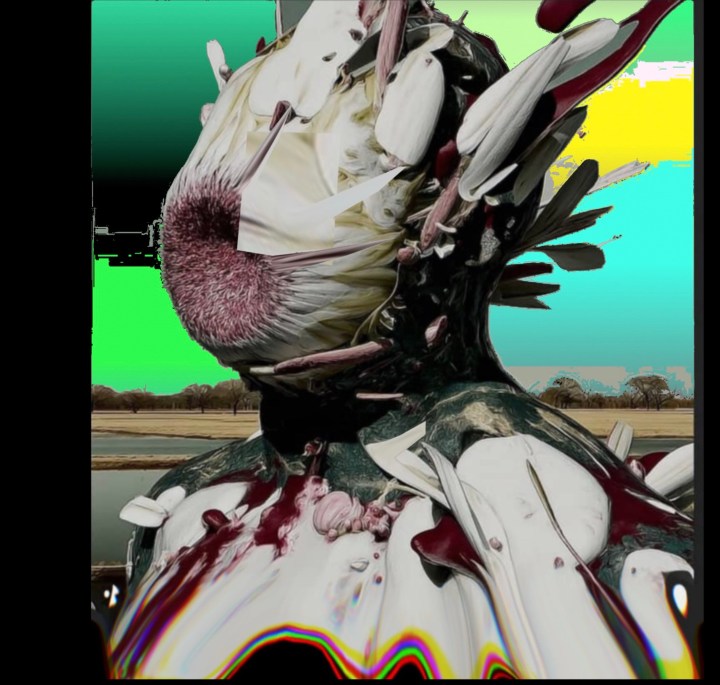
The images in this show—petal-skinned figures, mask-faces collapsing into botanical surfaces, totemic temples decorated with glyphic bodies—are not simulations of existing aesthetics. They are evolutions, emergent mutations that belong wholly to the present.
II. Mark Fisher and the Exit from Capitalist Realism
Mark Fisher wrote in K-Punk: “The slow cancellation of the future is the suppression of the capacity to imagine alternatives.”
AI art, for all the panic surrounding it, solidifies this cancellation, making the furure, as William H. Burroughs proclaimed, solid enough to be destroyed . It produces speculation faster than capitalism can package and market them as product. It generates imagery that refuses the fiscal logic of the poptimistic creative market—the recognizable, upbeat, frictionless aesthetic demanded by platforms, brands, and the ever omnivorous algorithm.
The imagery in Floral Spector is not economically optimistic.
It is feral, uncanny, excessive, speculative.
It resists being monetized into “content.”
It does not aspire to be smoothly logical.
Fisher warned that capitalist realism would attempt to “neutralize desire” by rendering novelty suspicious or dangerous. The outrage at AI art—its supposed “wrongness”—is thus a symptom of a culture terrified of its own capacity to mutate. But The Wrong Biennale exists precisely to harbor the mutational, the unlicensed, the aesthetically ungovernable.
And Floral Spector embraces this mandate fully.
III. The Sednacene as Method
The Sednacene, a speculative geological epoch of your own cosmology, is not merely a metaphor—it is a method.
It proposes:
● cross-species sensing
● morphic empathy
● fluid identity zones
● consciousness as distributed across bodies, tools, and terrains
This exhibition enacts the Sednacene by merging three artistic consciousnesses with that of multiple machine intelligences. The result is neither posthuman nor prehuman but interhuman—a zone where thought hybridizes with computation, where images evolve by passing through different minds (organic and synthetic), and where aesthetic forms no longer belong to a single subjectivity.
In this sense, the collaboration is not metaphorically biological; it is fundamentally ecological. Klink, Wurds, and Kline are not coauthors but cohabitants within an expanded sensorium. Their work is not “AI art” but Sednacene media—an emergent genre in which boundaries blur and cognition pollinates across interfaces.
IV. Floral Speciation: Toward New Emotional Architectures
The works in the exhibition depict figures dissolving into flowers, bodies softened into petals, faces imprinted with botanical memories. The architectures are ceremonial, totemic—high red towers inscribed with human glyphs, as if built by a future civilization reconstructing humanity through fragments.
This floralization is not decoration.
It is metamorphosis.
The floral body is a refusal of the hard human outline.
It suggests that the future of consciousness—biological or artificial—will be porous, affective, and excessively alive.
In Floral Spector, the flower becomes a technology.
The body becomes an interface.
The image becomes a living system.
The videos shift, bloom, wilt, and reassemble themselves, presenting not a narrative but a set of emotional architectures—structures built from unease, wonder, delight, and the uncanny bloom of unfamiliar life.
V. A Future That Is Allowed to Grow
Floral Spector occupies a crucial cultural frontier.
It stands in opposition to the current anxiety, fear, and moralizing around digital creation. The thesis of the exhibition is simple:
AI/new media art is culturally inventive, aesthetically generative, and vital to the evolution of 21st-century form.
This is not a future to fear—it is a future to cultivate.
The works here do not hide their hybridity; they celebrate it. They show that when artists engage with machine intelligences intimately, critically, and poetically, the result is not a flattening of culture but a proliferation of it.
The future is not collapsing.
It is flowering.
We only need to stop policing the garden.
 Pink Noise Projects